
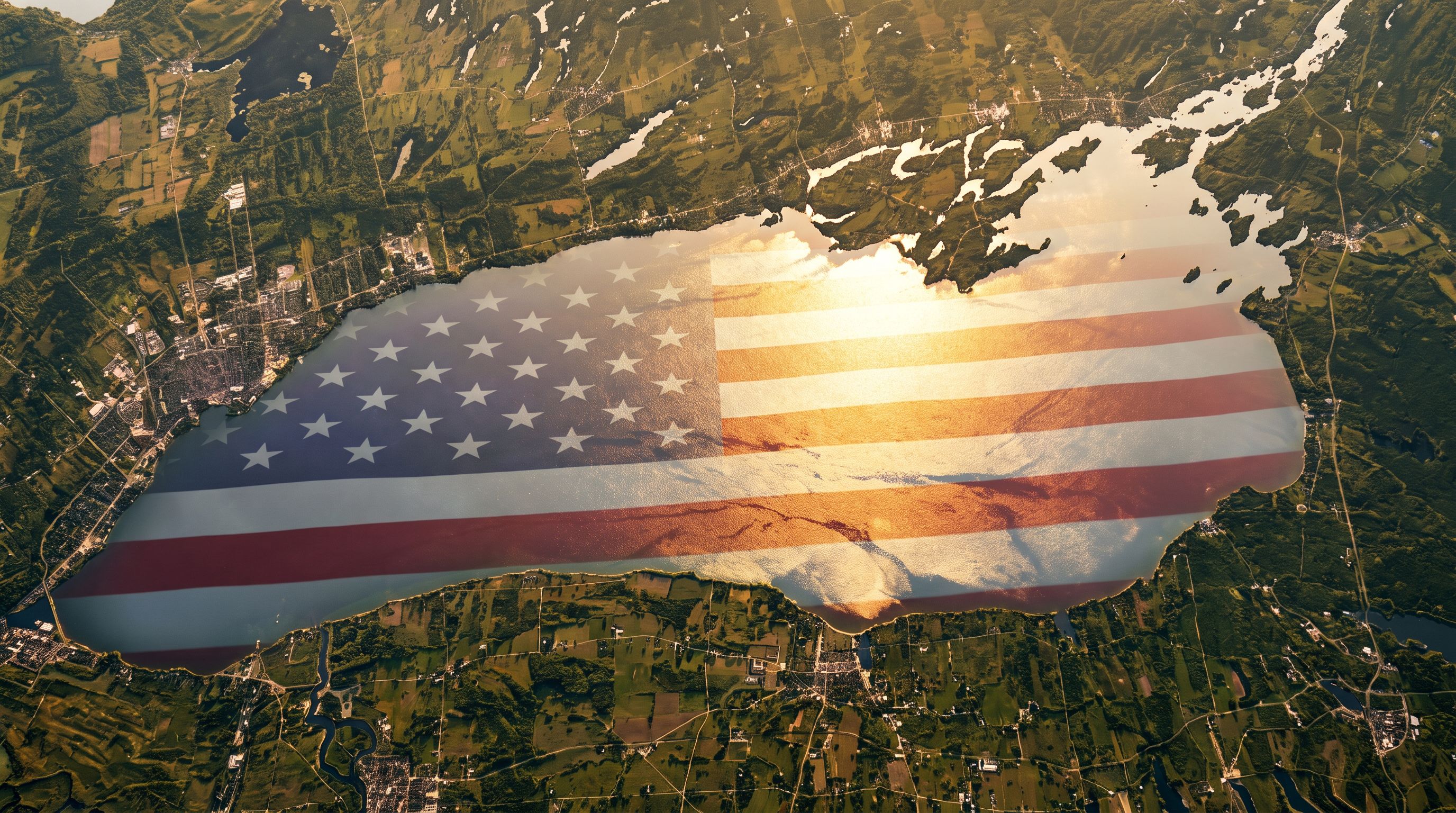
At roughly 7 a.m. on Monday morning, President Trump posted a message on Truth Social announcing that "the United States is giving serious consideration to changing the name of Lake Ontario to Lake America in that we don't expect to be doing much business with Ontario any longer." He signed it off formally — "Thank you for your attention to this matter! President DONALD J. TRUMP" — because when you're about to rename one of the Great Lakes, manners still matter.
Then he posted a stylized map with "Lake Ontario" crossed out and "Lake America" written over it in gold lettering.
This isn't even the first body of water Trump has rechristened. In January 2025, he signed an executive order renaming the Gulf of Mexico to the Gulf of America. That one stuck. Federal agencies updated their maps. The media threw a fit for about two weeks and then moved on. So when Trump floats "Lake America," the question isn't whether he's serious. The question is whether Canada wants to find out.
The timing here is everything. On August 21, U.S.-Canada trade negotiations collapsed, with both sides blaming each other. Three days later, on August 24, Trump announced 50% tariffs on all vehicles, automotive parts, and steel coming from Canada, effective January 1, 2027. He added that Canada "will be treated like a state no longer." Canada fired back the next day with retaliatory tariffs on $19.94 billion worth of U.S. goods — counter-tariffs of 15%, 25%, and 50% across approximately 700 American products, set to take effect September 8.
So Trump didn't just wake up and decide to mess with a lake name. He's in the middle of a full-scale trade war with a country that apparently thinks matching us dollar-for-dollar on tariffs is a winning strategy when their entire economy runs on selling us things.
Ontario Premier Doug Ford responded the way you'd expect. "I know Canadians. We're always going to call it Lake Ontario," he said. He also called Trump "the king of bankruptcies" and a "bully" and a "dictator" — which is a lot of name-calling for a guy whose province ships roughly a quarter of its exports south of the border.
Ford did land one interesting number, though. "Nine million Americans wake up every single morning to produce a product, a widget, or a service for Ontario," he said. That's supposed to be a warning to Trump. But read it again. Nine million Americans are producing for Ontario. That's the dependency Ford is admitting to while simultaneously calling Trump a dictator for leveraging it.
Canada's Industry Minister Melanie Joly waved it off as theater. "While all these shenanigans are happening, we'll just be smart, we'll be strategic, and we'll fight back," she said. Smart and strategic. From the government that just slapped retaliatory tariffs on 700 American products and expects that to end well for a country of 40 million people trading with a country of 340 million.
The Canadian response follows a predictable pattern: outrage, insults, vague promises to "fight back," and zero acknowledgment that Trump's trade leverage is structural, not rhetorical. Canada's economy is built on access to the American market. That's not an insult. It's a spreadsheet. When your biggest customer tells you the terms are changing, calling him a bully doesn't change the math.
Carney thought he could get a better deal because the midterm elections are coming in less than 3 months and he thought that meant he had President Trump over a barrel. Little does Carney know that despite Trump wanting desperately to keep Republican majorities in both houses of Congress that doesn't mean he'll roll over and make a deal that will hurt American workers. Trump cares way more about Americans than winning, Carney overplayed his hand.
The Lake America proposal is vintage Trump — part provocation, part negotiating tactic, part genuine willingness to follow through if pushed. The Gulf of America proved the model works. Name something outrageous. Let the other side spend a week being offended. Meanwhile, the tariffs are already on the calendar and the clock is ticking toward January 1.
Ford eventually softened his tone. "It got a little personal yesterday," he admitted. "It's time to get back to the table and let's negotiate a fair deal because it is hurting the U.S., it is hurting Canada." That's the first honest thing anyone in Ottawa or Queen's Park has said in a week. It's also an admission that the tariffs are working exactly as intended.