
709,841 Michigan citizens signed a petition to put citizens-only voting and photo ID requirements on the state ballot. They needed 446,198 signatures — and gathered 59 percent more than required. The state sat on those signatures for 166 days, then declared the petition 17 names short of validity.
Seventeen. Out of 709,841.
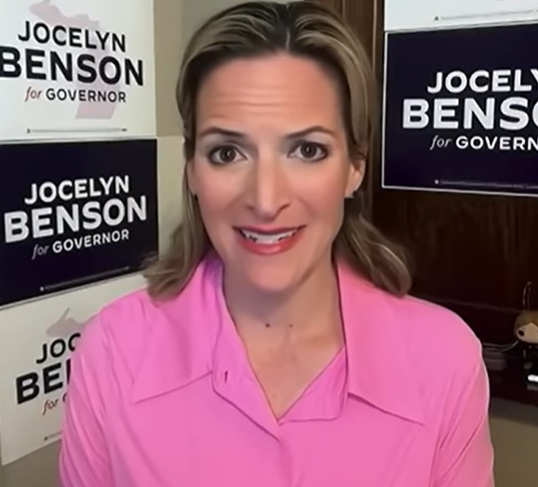
The group fought back. The case climbed to the U.S. Supreme Court. And now Democrat Secretary of State Jocelyn Benson is telling Justice Brett Kavanaugh his court has no business here.
Readers outside Michigan may not know Benson's name yet. They should. She is the state official who has spent years building a wall between Michigan voters and any requirement that proves who they are. She called the federal SAVE Act — which would simply require proof of citizenship to register to vote — "dangerous" and "a trick." She has fought proof-of-citizenship requirements, photo ID requirements, and every other measure designed to confirm that the people voting in Michigan elections are American citizens entitled to do so. Her own office acknowledged that 15 non-citizens illegally cast ballots in Michigan's 2024 election. She responded by fighting harder against the measures designed to stop it from happening again.
This is the official who decided 709,841 signatures weren't enough.
Here's what those signatures were for. A group called Americans for Citizens Only Voting sought to place a constitutional amendment on the Michigan ballot requiring proof of citizenship and photo ID to vote. A Remington Group poll found 87 percent of Michigan voters — across party lines — oppose non-citizen voting. The petition cleared the required threshold by more than 263,000 signatures. It should have sailed to November.
Instead, Benson's Bureau of Elections, run by Director Jonathan Brater, sat on the petitions from March 4, 2026. The bureau didn't release so much as a 1,000-signature sample for public review until July 24th — nearly five months later. The full staff report arrived August 17th. Its conclusion: the petition was 17 signatures short of validity.
The campaign found 23 affidavits from signers whose signatures had been rejected. But here's the detail that explains everything: the bureau disqualified those signatures by comparing them to records in the Qualified Voter File — a database owned and controlled exclusively by the Bureau of Elections. Petition organizers were never shown the records used against them. The bureau set the timeline. The bureau selected the sample. The bureau ran the comparisons against a database only the bureau could see. The bureau declared the petition dead.
Then the bureau's boss told the Supreme Court not to look.
The hypocrisy requires its own paragraph. In 2020, Benson instructed Michigan county clerks to stop matching signatures on absentee ballots — and to assume that signatures matched. Assume. Petition signatures need to match exactly. Absentee ballot signatures get a presumption of validity without verification. The standard depends entirely on which one helps Benson win.
The two Democrat members of the Michigan Board of Canvassers — including Heather Cummings, appointed by Governor Whitmer — voted to keep the measure off the November ballot entirely. That vote sent Americans for Citizens Only Voting to the Supreme Court. Attorney Mark Brewer has been fighting to kill the initiative through the courts as well. The September 4th finalization deadline is now running.
Benson's argument to the Supreme Court is that this is a state matter, best left to state courts — the same courts that would be reviewing decisions made by a bureau she controls, under standards she sets, using records she controls, on a timeline she stretched to 166 days.
The significance of where this stands is in Kavanaugh's question itself. When a Supreme Court Justice specifically requests a formal response in an emergency petition, it signals interest. One member of the Court looked at a state where the government controlled the database, the timeline, the sample selection, and the verification standards — and thought it worth a question.
Benson's answer was: please don't ask.
When your best legal strategy is asking the court not to read the file, the file probably isn't great.