

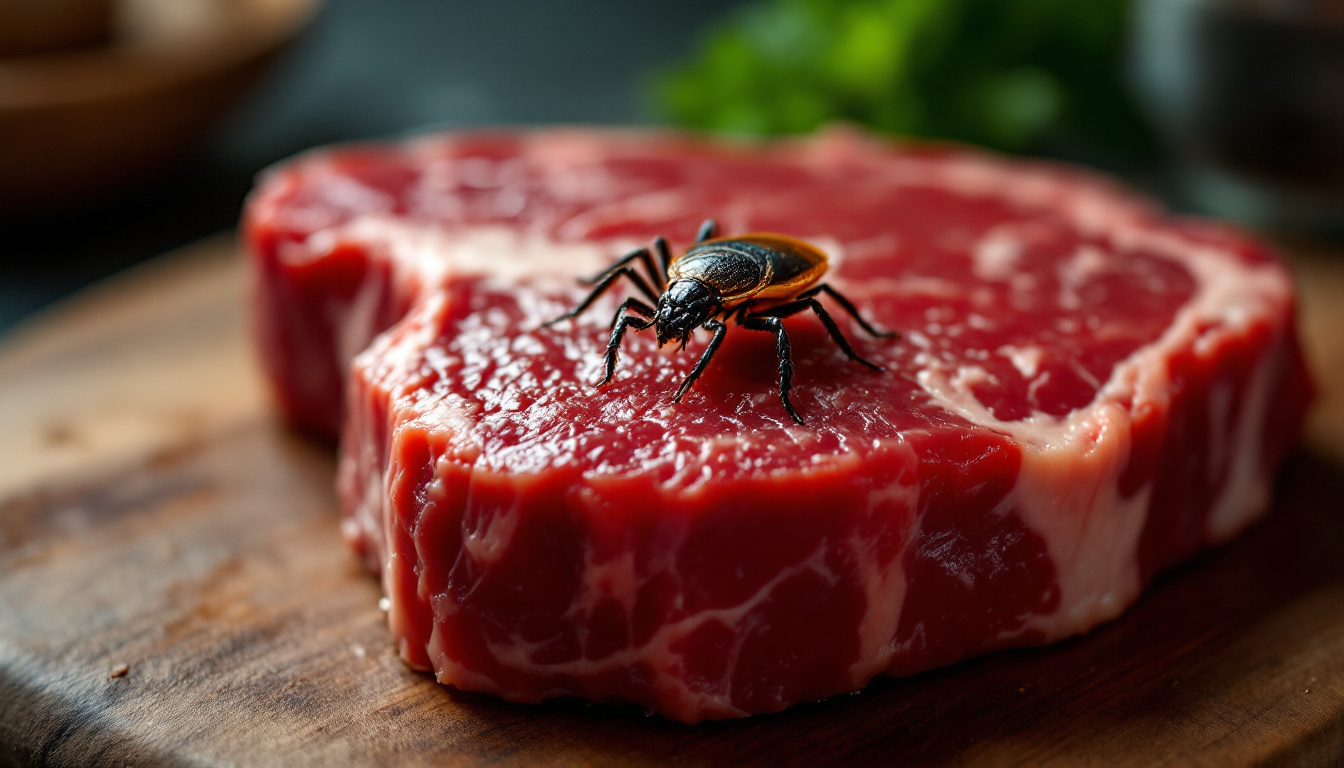
A decade ago, almost nobody had heard of alpha-gal syndrome. Today, over 450,000 Americans have been diagnosed with it — a lifelong, incurable condition caused by a tick bite that triggers severe allergic reactions to red meat. Not a sensitivity. Not a preference. An allergy. One bite from the wrong tick and your body permanently rejects the hamburger you've been eating your entire life.
Oh, and the number of cases has increased 5,566% in ten years.
Five thousand, five hundred and sixty-six percent.
That's not a trend. That's a project.
Now, before we get into what's actually going on here, let's be clear about what alpha-gal syndrome does to a person. It doesn't just make you uncomfortable at a cookout. Depending on severity, it can cause hives, gastrointestinal distress, anaphylaxis, and in serious cases, life-threatening reactions. There is no cure. The only treatment is to stop eating red meat entirely. Forever. Your doctor will hand you a pamphlet and suggest you try lentils.
So here's the question nobody in the mainstream media seems interested in asking: who benefits when millions of Americans permanently lose the ability to eat beef?
Let's follow the money.
Bill Gates — the same Bill Gates who is currently the largest private farmland owner in the United States — said in 2021, with complete sincerity: "I do think all rich countries should move to 100% synthetic beef. You can get used to the taste difference, and the claim is they're going to make it taste even better over time."
That's not a casual opinion. That's a business plan.
Gates has invested in Beyond Meat. He has invested in Impossible Foods. He has funded research into cultured meat startups through his Breakthrough Energy initiative. The man owns more American farmland than anyone in the country, is actively investing in the companies that sell fake meat alternatives, and publicly believes you should stop eating the real thing. And somewhere in the mix, his foundation has also funded research into genetically modified ticks.
We're not saying those things are connected. We're just saying they're all true at the same time.
Meanwhile, over at the World Economic Forum — Klaus Schwab's club for people who believe they should make decisions for the rest of humanity — the official position is that you will eat less meat, you will eat insects instead, and you will be happy about it. The WEF has published multiple pieces promoting insect protein as the future of food, arguing that beef consumption must be drastically reduced to save the planet. Their vision of your dinner plate does not include a steak.
Now let's talk about what farmers are reporting.
Across rural America, landowners have been posting videos and accounts of helicopters flying low over their properties — sometimes dropping what appear to be lines or materials across the land. Days later, tick populations on those same properties explode.
Farmers are finding large numbers of ticks on their animals, on their fences, on their fields. Some have reported finding what appear to be boxes or containers on their land they didn't put there.
Nobody in authority is seriously investigating these reports. The official explanation — to the extent there is one — is climate change. Warmer temperatures, expanding tick habitats, the usual. Nothing to see here. Definitely not helicopters.
Here's what makes the "morally good" angle so hard to dismiss. A scientific paper — an actual, published academic paper — argued that it could be ethically justifiable to spread meat allergies through engineered tick populations. Not as a hypothetical thought experiment. As a moral position. Someone sat down, wrote that argument out, and got it published. The idea of deliberately engineering a mass meat allergy into the American population has been floated in academic circles as something to consider.
Consider that for a moment.
You have a 5,566% increase in a meat allergy caused by tick bites. You have the most powerful people in the technology and finance world publicly advocating for an end to beef consumption while investing in the companies that replace it. You have academic papers suggesting that spreading such allergies would be morally defensible. You have farmers posting videos of unidentified helicopters hovering over their land followed by tick infestations. And you have a research community with access to genetically modified tick technology funded in part by the man who told you to stop eating beef.
Maybe it's all a coincidence. Tick populations expand naturally. Climate does affect habitat ranges. Alpha-gal syndrome was likely underdiagnosed for years before awareness increased. These are fair points.
But 5,566% is a very large coincidence. And the people positioned to profit most from a nation of involuntary vegetarians have very loudly told us, in their own words, exactly what they want your dinner plate to look like.
They just didn't mention the helicopters.