
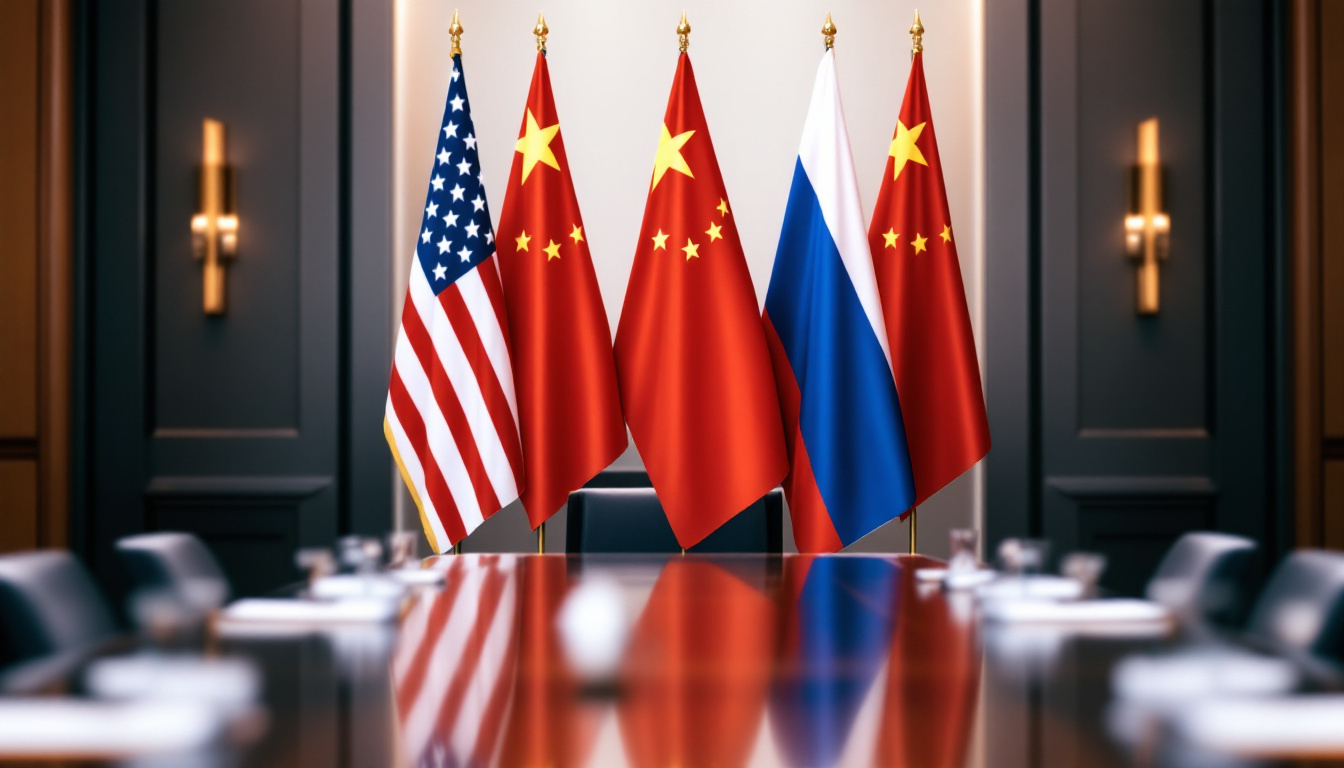
At approximately 3 a.m. Eastern Time on November 19th, Donald Trump walked into a government-owned lakeside resort called Kylin Villa in Shenzhen, China, and sat down between Xi Jinping and Vladimir Putin for the first trilateral summit between the leaders of the United States, China, and Russia in history.
The guy the media spent nine years saying would start World War III just told the two men most capable of starting one to reduce their nuclear arsenals. To their faces.
Trump had already met privately with Putin for roughly 40 minutes earlier that day on the sidelines of the 33rd APEC Economic Leaders' Meeting, with Secretary of State Marco Rubio and Treasury Secretary Scott Bessent in the room alongside Russian Foreign Minister Sergey Lavrov. Then came a bilateral with Xi that stretched past an hour at Kylin Villa. Then the main event — the three-way sit-down that lasted over an hour, covering nuclear arms, Ukraine, Iran, and energy security.
"Too often, past leaders avoided talking to nations with whom they had disagreements," Trump said during the trilateral session. "But no problems were ever solved under the old school refusing to talk about them."
That's not a throwaway line. That's a direct shot at every administration — Republican and Democrat — that treated diplomatic engagement with adversaries as something to be earned rather than pursued. The foreign policy establishment spent decades insisting you don't sit down with enemies until preconditions are met. Trump's precondition was showing up.
"We are really making history," Trump told Xi and Putin. He wasn't wrong. No American president has ever convened the leaders of the world's three largest nuclear powers in the same room for direct talks. Xi, speaking through a translator, seemed to agree with the gravity of it. "Our positive interaction is not optional, but a must," the Chinese president said.
Putin used the opening to reference Ukraine directly. "Our countries have numerous shared interests in the settlement of regional conflicts, including, obviously, the conflict in Ukraine," he said. Trump's response was measured but pointed: "I think things are happening. I think that he and I hope the other side would like to see an end to that war."
The nuclear question dominated. Trump pushed both leaders on arms reduction and acknowledged the difficulty out loud. "It's a very hard thing to do, because once you have the nuclear weapons, it's very hard to not have them," he said. Xi called nuclear weapons a "sword of Damocles hanging over humanity." By the end of the session, all three leaders reaffirmed that a nuclear war "can never be fought" — and agreed to open a formal dialogue on nuclear risks.
Trump also pressed Xi on Iran and energy. "Both the United States and China have an interest in ensuring that energy flows through the Strait of Hormuz, and that Iran cannot have a nuclear weapon," he said. "We both feel that very strongly on both points." Finding common ground with Beijing on Iran — in front of Moscow — is the kind of three-dimensional positioning that doesn't happen by accident.
Special Envoy to the Russian President Kirill Dmitriev told Fox News that "the dialogue between President Putin and President Trump is crucial both to resolving the conflict in Ukraine." The NY Post reported Trump dismissed traditional diplomatic norms as "old school" — the kind of framing that would have triggered a week of cable news panic two years ago and now just looks like the way business gets done.
No formal agreements were signed. No joint statement was released immediately after the talks wrapped around 5 a.m. Eastern. A Bloomberg reporter was barred from the trilateral after questioning Trump about Nvidia CEO Jensen Huang during the bilateral sessions — Chinese officials pulled her credentials despite White House objections.
Three nuclear powers. One table. The American president told both of them to cut their arsenals, got them to agree a nuclear war must never be fought, and opened a formal channel for arms dialogue. He was back on Air Force One before most of Washington woke up.