
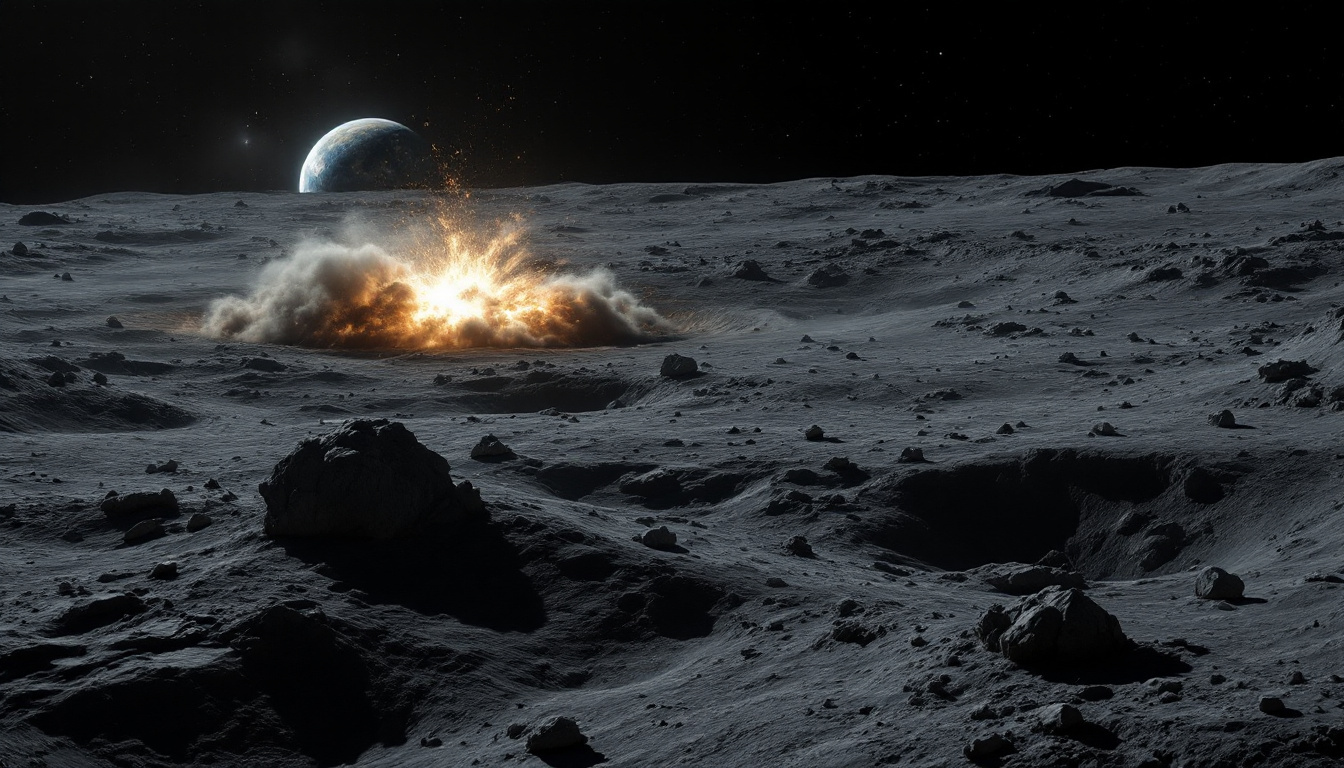
On Wednesday morning at 2:34 a.m. ET, a 10,000-pound hunk of discarded SpaceX Falcon 9 rocket will slam into the moon near Einstein Crater at 5,400 miles per hour. The impact will release energy equivalent to 3 tons of TNT, blast a crater roughly 90 feet wide and 16 feet deep, and shoot a plume of lunar dust approximately 3 miles into the black sky above the surface.
NASA's plan to get astronauts back to the moon? That's penciled in for 2028.
The spent upper stage, designated 2025-010D, has been tumbling through space since January 15, 2025, when the Falcon 9 launched from Vandenberg Space Force Base carrying two lunar landers — Firefly Aerospace's Blue Ghost 1 and ispace's Resilience. Blue Ghost successfully touched down on the lunar surface on March 2, 2025. Resilience crashed 90 seconds before landing. The rocket's second stage, having done its job, was left in a high orbit with no plan for disposal. Eighteen months later, the moon's gravity finally won the argument.
Benjamin Fernando, a postdoctoral researcher at Los Alamos National Laboratory and lead author of the impact study, called it a "calibration event to test all of the techniques that we use for studying natural impacts." Scientists don't get to schedule asteroid strikes. But when 4,000 kilograms of American-made rocket stage announces its arrival date weeks in advance, you set up every telescope you've got.
"We expect that to vaporize the booster, create a flash of light, probably a plume of ejecta," Fernando said. "If we can measure the composition of that, that tells us something about the composition" of the lunar surface itself.
Now, predictably, the coverage has drifted toward hand-wringing about "space junk" and the supposed recklessness of private companies launching too many rockets without tidy disposal plans. The framing writes itself: Elon Musk is polluting the moon.
Which is an interesting objection to raise about a company that has revolutionized launch costs, landed reusable boosters on drone ships, and delivered more payload to orbit than every other launch provider on Earth combined. The upper stage that's about to redecorate Einstein Crater completed its mission — it put two lunar landers on a trajectory to the moon, one of which actually landed. The "junk" did its job. It just didn't disappear politely afterward.
Fernando himself acknowledged the bigger picture: "These sorts of things are going to happen more and more often." More rockets means more spent stages. More spent stages means the occasional unplanned lunar remodel. The question is whether that's a crisis or a cost of doing business in an era when private enterprise is actually reaching the moon — something the federal government has been promising and failing to do for over half a century.
NASA is slated to construct Artemis Base Camp near Shackleton Crater at the lunar south pole. That's the plan, anyway. We've had lunar base plans since the Nixon administration. SpaceX, meanwhile, is launching so frequently that its discarded hardware is making unscheduled deliveries to the surface.
"Watching this one gives us a rare chance to open up ejecta-plume science and calibrate those models against a real event, which matters for every future thing we deliver to the moon," one researcher noted in the campaign paper. In other words, even SpaceX's trash is generating more useful science than most government-funded studies.
The Artemis program has spent north of $90 billion and counting. The Falcon 9 upper stage cost a fraction of that, did exactly what it was built to do, and is now providing a bonus science experiment on its way out. Government programs get congressional hearings. Private rockets get results — and apparently, the occasional 90-foot souvenir on the far side of the moon.
The impact happens Wednesday, August 5 at 2:35 AM Eastern. If you have a telescope and clear skies, point it at the Moon — the debris plume could be visible for several minutes after impact. Eastern U.S. and Canada have the best view. For livestream coverage, check Space.com